
Election day episode
On the Nov. 6 Election Day episode of Reasonably Catholic, we hear from two experts—John Finn, Wesleyan professor of government, and Mark Silk, director of Trinity College’s Center for Religion in Public Life—about the Catholic bishops’ objections to the contraception mandate in the Affordable Health Care Act.
“The bishops are on the wrong side of the argument here”
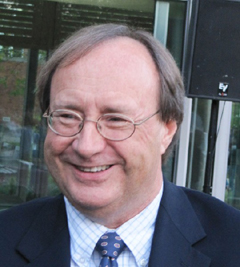
John Finn, professor of government at Wesleyan University—“Every time there’s a new election…I become more and more disaffected, to be honest.”
Listen to more from my interview with Prof. Finn about the undecided voter:
Excerpts from the interview with Prof. Finn:
• On Catholic voting trends:
“It’s my sense that, over the years, and progressively so with each election, Catholics vote less and less distinctly as a bloc. Now maybe there’s something about the mandate, and the bishops’ fortnight that will galvanize Catholics to vote more as a single demographic unit, but I’m inclined to think not. I would be very surprised if we see any real substantial change in how Catholics have voted in past elections.”
• On freedom of religion:
“There are a lot of basic misconceptions and myths going on about what freedom of religion means, about what the First Amendment means, about who has the power to define it, and while I think the bishops are ultimately mistaken as a matter of constitutional law, the position they hold, that the mandate directly interferes with their free exercise rights, is not a crazy one. I think t’s mistaken but it’s far from crazy. And in any event, it may be the one that some future court ends up adopting.”
• On the U.S. bishops’ challenge to the Affordable Health Care Act:
“For the last 10 or 20 years or so, it seems reasonably clear as a matter of constitutional law, distinct from constitutional principle, that the bishops are on the wrong side of the argument here. There’s not a whole lot of support in the case law for a position that says that an otherwise valid, neutral law which doesn’t have the intent or purpose of picking on religion in particular should nevertheless not be applied because it offends your religious faith. … The rule is clear that there isn’t much room for an exemption for the Catholic Church just because they think it violates their faith….This would make every religion a law unto itself.”
• On whether compromise on the mandate is possible:
“There have already been several articles in Commonweal , for example, and other places, to suggest there are perfectly reasonable accommodations the Church could make within its own theology that would allow it to live with some form of the mandate. “
• On the bishops “Fortnight for Freedom” campaign:
“I’m wondering why we had the fortnight on the mandate but we haven’t had, in my life, anyway, that I can recall, a fortnight dedicated to the Church’s larger proposition that health care is a fundamental right for everyone, or that we ought to have a fortnight against poverty.
“Most Americans don’t buy this as a threat to freedom of religion”
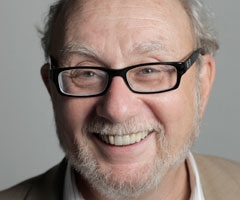
Prof. Mark Silk, director of the Leonard Greenberg Center for Religion and Public Life at Trinity College, talking about public reaction to the U.S. Conference of Catholic Bishops’ objections to the Obama administration’s Affordable Health Care Act: “Most Americans don’t buy this as a threat to freedom of religion.”
Listen to Prof. Silk on polling:
Excerpts from the interview with Prof. Silk:
• On the bishops’ giving Catholics more reason to leave the Church:
“To what extent are they prepared or even eager for a smaller, more obedient church, without all these annoying people running around saying, ‘baloney’?”
• On prospects for an end to the abortion debate:
“I’d even say this about some of the pro-choice folks – this is an issue where a lot of people don’t want to find common ground. There have been efforts to try to go there. There’s a certain amount of industry – industry in the sense of social movement organizations that raise money – that, really, would go out of business if this issue were solved. … so I don’t’ see much likelihood of this disappearing.”
• On why the bishops are so focused on birth control:
“Personally, I think there is a kind of shell-shocked quality to the Church that helps explain a lot of the behavior: as a result of the abuse scandal. [It happened] not just in Boston, not just in New England, not just in the United States, but all over the world and in the Vatican and …I think at some level, the sheer unhappiness and rage of leaders of the greatest religious institution in the history of the universe at having to be regarded as a species of lower order of being, and morally corrupt and so on … I think it really sort of – it kind of drove them nuts.…So in the large scale of things, the turn to the right and the slightly out of control quality of the bishops, I just have to believe it has something to do with the shock of the scandals.”
• On the Catholic vote:
“Catholics are the most representative religious body of any religious group. That is, if you take all the Catholics and you tell me how they vote in a given election, I could tell you who won the election.”
Link to NYT Thomas Friedman column: “Why I am pro-life”
“I wanted them to look like popes”
In the Oct. 30th episode of Reasonably Catholic: Keeping the Faith, photojournalist Judith Levitt talks about her photographic portraits of women priests, which ran in the Sept. 30th New York Times Sunday Review section. See the full gallery here.
One of the many interesting aspects of Levitt’s photographs is that, contrary to what you might expect, the women are not shown performing such priestly actions as consecrating the Eucharist at Mass. Rather, the portraits channel the spirit of Renaissance art, with the women seated, holding a book and wearing robes and stoles in front of a deep blue velvet backdrop.
To see the women in such traditional regalia may bring comfort, says Levitt, to those like herself who have fond memories of having grown up Catholic but who find it hard to feel at home in the Church today.

Bishop Patricia Fresen. Photograph by Judith Levitt
Bishop Patricia Fresen, formerly of South Africa, now of Germany, was a Dominican nun and university professor—who trained male seminarians how to be priests!—before becoming a Roman Catholic priest herself in 2003, resulting in her being forced to leave her community. In Germany, bishops involved in the women-priests movement asked her to become a bishop and bring the movement to the United States so it could grow. As priest Gabriella Velardi Ward, whom Fresen ordained and who is a subject of an upcoming Reasonably Catholic episode, tells it, the bishops explained, “The women in the United States are well-educated and not easily intimidated by Rome.”
Fresen, photographed in her home in Germany, has since ordained many women priests and is a shepherd of the movement.
Voice of the Faithful: Ten years of prodding the hierarchy to listen to Its better angels
The Oct. 16 episode of Reasonably Catholic: Keeping the Faith goes to Boston to attend the 10th anniversary conference of Voice of the Faithful, a lay organization that formed in reaction to revelations of clergy sexual abuse.
We hear from attendees and speakers who look back at VOTF’s beginnings and ahead to its future. Suffice it to say, VOTF has found its voice.
Those heard in this episode include:
Rev. James Connell, pastor of Holy Name of Jesus and St. Clement Parishes in Sheboygan, Wisconsin, a canon lawyer who advocates on behalf of victims/survivors of clergy sexual abuse of minors.

James Connell
Illinois Supreme Court Justice Anne Burke, a longtime children’s advocate.

Anne Burke
David Clohessy, executive director of SNAP (Survivors Network of those Abused by Priests), the nation’s largest and oldest self-help group for clergy molestation victims.

David Clohessy
This article I wrote about the conference for Today’s American Catholic will appear in that newspaper’s upcoming issue:
BOSTON – “Why aren’t the bishops here tonight?” a voice in the ballroom called out.
“They were invited,” replied the master of ceremonies with a shrug. “We didn’t get a terribly negative response, but – they’re not here.”
Bishops who are not there – in so many senses of the phrase. That was a recurring theme of the 10th anniversary Voice of the Faithful conference in September.
With the exception of Blessed Pope John XXIII, to whom the conference was dedicated, and Milan’s recently departed Cardinal Carlo Maria Montini, who was applauded for admitting that the Church is “200 years out of date,” a number one speaker called a gross underestimate, the hierarchy took it on the chin for everything from their financial opacity and obstructionism to their obsession with “pelvic zone issues” and liturgical rubrics, down to their baroque ceremonial garb.
The event drew about 450 people to the Marriott Boston Copley Place Hotel, barely a dozen miles from where Voice of the Faithful began with listening sessions in a church basement in Wellesley. The organization’s membership now numbers 30,000 worldwide. “I wouldn’t still be a Catholic if it weren’t for Voice of the Faithful,” said one attendee who was sure she spoke for many.
Judging from the sea of gray hair, and by doing a quick bit of math, one was reminded that the conferees had come of age 50 years ago, as Vatican II shook the ground, a formative event that still powerfully reverberates for them, no matter that Rome pretends it didn’t happen.
“I’d like to see the Church change so I don’t have to leave it, that’s all,” said Bud Roche, a retiree from Needham, MA, and Florida during the opening cocktail party. “It’s asinine a woman can’t become a priest. A woman can’t even become a deacon. Take a look at the nuns, what they’re doing to them. I’ll tell you, if someone put together a deal, a Catholic Church of America, I’d run there, and I tell you, half the women I know would run there, and a lot of nuns would run there.”
Roche and his wife Eileen are Republicans, but liberal-minded when it comes to Church reform. Pope John Paul III “wiped out” Vatican II, “and now they’re making him a saint! Naming parishes after him in Boston! Insane.”
A short documentary film about Voice of the Faithful’s beginnings illustrated how steep the learning curve was for those brave souls challenging their Church for the first time. One interviewee drew chuckles when she recalled having thought, “Oh, wouldn’t Cardinal Law love to know!” that the laity was willing to pitch in and help fix the crisis.
The conference speakers – a roster of progressive Catholic authors and activists – did not so much make presentations as raise battle cries.
“Pride, untruths, protecting the institution at all costs and treating the laity like serfs – have we learned no lessons in a decade?” said Anne Burke, an Illinois Supreme Court justice and former chair of the United States Conference of Catholic Bishops National Review Board, in an opening address. “We have no interest in returning to the way the Church of our youth was led, the church of cover-up, secrets and hidden crime.”
Another speaker, David Clohessy, executive director of Survivors Network of those Abused by Priests, called on Catholics to stop giving money to all Catholic institutions, including to their parishes. Such donations, he said, only build the “power, reputations, prestige and war chests of Church officials,” with the cash used to hire defense lawyers, PR firms and lobbyists to fight sexual abuse claims. When people tell him that they don’t want to hurt lay employees, Clohessy says he replies: imagine if, during the civil rights movement, people refused to boycott so as not to deprive bus drivers of jobs.
“Get over that,” he said.
This was just the kind of incendiary challenge which Voice of the Faithful might have cringed at in its early days, as the organization sought to distinguish itself from such church-reform groups as Call to Action.
Pat McSweeney, who was passing out brochures at the Call to Action table in the exhibits room, was an early member of both. She recalls attending one of the Wellesley meetings – even before Voice of the Faithful had a name – and mentioning Call to Action as a model.
“I could feel people around the table stiffen. Their perception was that it was too radical,” she said, in its advocacy of optional celibacy and the ordination of women. “And I could tell from some subsequent meetings that Voice of the Faithful people were intent on sympathizing with the victims and with supporting the priests of integrity, but they didn’t want to ruffle the feathers of the bishops or change the Church, particularly.
“Now I’m here ten years later and I could hear from the talks that were given last night that Voice of the Faithful has evolved and they’ve realized it’s up to them, the laity, to make the changes that need to be made, to bring healing and honesty and integrity to the Church.”
Several times over the two days, different speakers said reforms may not happen “in our lifetime.” Nonetheless, attendees say they have evolved so far beyond their previous “pay, pray and obey” approach to Catholicism that they “could never go back.”
Voice of the Faithful now lists shaping structural change among its goals, specifically in the areas of priestly celibacy, women’s ordination, clericalism, and lack of lay input into decisions about, for instance, the selection of bishops.
In answer to a question about why more priests aren’t involved in Church reform, speaker Rev. Donald Cozzens, author of several books calling for Church reform, blamed priests’ immaturity. But “perhaps we are maturing and finding our adult voice,” he said.
“We priests are vassals to our bishop. The vassal’s primary virtue is loyalty and we priests need to talk about what real loyalty is. It should be to the gospel.” Toward the end of the conference, attention turned toward the absence of young people from both Voice of the Faithful and the Church, and what to do about it.
Sarah Politano, of Wisconsin, a student at Harvard Divinity School, said during a break that she practically has to decide anew every day to stay Catholic. “Especially after learning how widespread the coverup was … it’s easy to feel exhausted already, and I’m only 25. I can’t imagine people who’ve spent their lives wrestling with these issues.” That they continue to do so, she said, is “inspiring.”
Several speakers said there’s little older Catholics can do but show by example how essential their faith is to them.
As Jamie Manson, a young columnist for the National Catholic Reporter, put it: “Name what’s meaningful about being Catholic … what treasures of Catholicism are worth rescuing from the burning building that is the institutional Church.”
Unlike in her grandparents’ day, when religion was woven into other aspects of community life, and people’s lives unalterably prescribed for them (marriage, children, husband working, wife at home), Manson said the lives of today’s young adults follow a more individualistic model.
“Community doesn’t tell young people today what they believe, what their values are, what their morality is. That kind of individuality is really unprecedented,” she said, and its impact on the Church cannot be overstated.
“Today’s young adults experience a Church that was tainted from the very beginning,” she said, and for which they feel “no nostalgia…They’d rather distance themselves from Church authority than spend time and energy trying to change it.”
Sure, whenever the Pope travels, the media focuses on hordes of ecstatic young people, but these are “highly orthodox” believers, for whom the Church is a refuge from such social changes as women’s equality and gay rights– “young folks who are afraid of the world.”
To reach better-adjusted youth, Manson advises speaking to their interest in social justice, on “God working through us sacramentally” to help the “poor and broken.”
“With our without the hierarchy, with or without our priests, with or without our parishes – honor what’s good and true and beautiful about the Catholic tradition.”
As members of Voice of the Faithful, she said, “the risks you took to speak life-saving truth to a religious behemoth has been an important model for young adults to grow up with.” She credited the organization with making possible the sexual-abuse prevention training, background checks and policies and procedures that were eventually implemented.
“On behalf of young adults who have benefited from your work and who will be in a safer, more accountable Church because of you, I say, happy anniversary!”
These photos show the “Lamentation Wall” at the conference, where attendees could post their sentiments.


Reasonably Catholic: Keeping the Faith, Oct. 2, 2012, archived show
On the Oct. 2, 2012, show: Denise Stankovics, editor of Today’s American Catholic, a nationally circulated progressive Catholic newspaper published out of Farmington, CT; Chris Allen-Doucot, of the Hartford Catholic Worker; and more.
Reasonably Catholic: Keeping the Faith, Oct. 2, 2012, archived show
On the Oct. 2, 2012, show: Denise Stankovics, editor of Today’s American Catholic, a nationally circulated progressive Catholic newspaper published out of Farmington, CT; Chris Allen-Doucot, of the Hartford Catholic Worker; and more.
Today is the Feast of the Guardian Angels
Today is the Feast of the Guardian Angels; I think I keep a dozen of them busy! The following wisdom about guardian angels comes from Reasonably Catholic’s official chaplain Fr. John Baptist Pesce:
Angels: these invisible, spiritual beings who are messengers sent by God to God’s people are a symbol of God’s transcendence and loving care for the people. They feature quite prominently in the history of the Chosen People (e.g., the book of Tobit). Today, we pay tribute to those heavenly messengers who can be seen as an expression of the divine solicitude to protect and accompany us on our earthly pilgrimage.
Pious Catholic belief—without it being defined as a dogma—maintains that God has assigned for our protection a messenger from heaven to accompany us. This may be another way of expressing that we are never alone but that God always accompanies us and we can rely on divine help.
Some of you may have been taught by sisters who advised you to move over a little in your chair to make room for your guardian angel. The lesson behind it has value. God is with us and angels are that symbol of the divine presence and concern. Angels may well come to us in human form as they did to our foremothers and forefathers in the history of the Hebrew.people.
Sometimes in certain cultures or among certain ethnic groups when someone does a good deed to another, the recipient of that benefaction says of the other, “What an angel you are!”…Which reminds us that we are to be the signs of God’s presence among his people. Not a wasted reflection to make on this feast day of the Guardian Angels.
Denise Stankovics
Here’s a nice head shot of Denise Stankovics, editor of Today’s American Catholic, who’ll be on the Oct. 2 show with Chris Allen Doucet of the Hartford Catholic Worker.

Denise Stankovics
Oct 2. show preview
Our next show airs from 4 to 4:55 p.m. on Tuesday Oct. 2 with these two special guests:
Denise Stancovics, editor of Today’s American Catholic, a nationally circulated progressive Catholic newspaper published out of Farmington, CT.
And
Chris Allen Doucot, of the Hartford Catholic Worker:
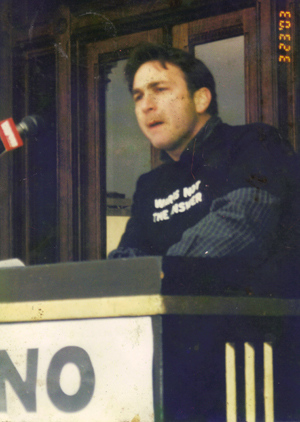
Speaking at a 2003 anti-war rally at the Connecticut state capitol.

Being carried away from a 1997 protest against the Seawolf nuclear fast-attack submarine.
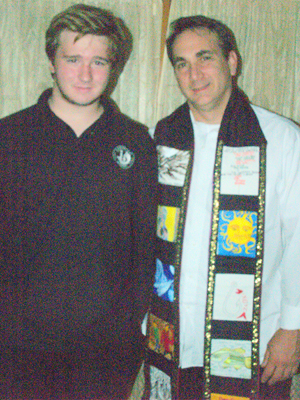
With his son Ammon on the occasion of Chris’s graduating from Yale Divinity School in 2008 with a master’s degree in religion. Chris is wearing a stole with panels made by friends.

Walking Marisol Reyes Hernandez down the aisle in about 2006. Marisol was the guest of the Catholic Worker when she was in high school.
Reasonably Catholic: Keeping the Faith airs every first, third, and fifth Tuesday at 4:00 p.m. EST on WESU 88.1 FM in Middletown, CT, and streams at wesufm.org.
Our patron saint
Listener Al Masciocchi sends along this photo of a plaque on a building in Baltimore.

Al reminds us that not only was St. Joseph of Cupertino known for his levitating during prayer, he was ordained as a result of correctly answering one question—the one answer he’d furiously prepared. (He had a learning disability.)
Writes Al: “He has long been one of my favorite saints. I learned of him in grade school from the Immaculate Heart of Mary nuns back in Philadelphia. He was the patron saint of test takers. I was taught a prayer, ‘Oh great St. Joseph of Cupertino who while on earth did obtain from God the favor to be asked only the questions you knew, obtain for me a like favor for this exam for which I am preparing.’
“I said that prayer before every test I took thereafter, up to and including every actuarial exam I ever took. And I’ve been telling my children the prayer since they started taking tests. I also remind them that the prayer always works better if you have studied 🙂
“I never knew much about St. Joseph until earlier this year. We were visiting my daughter who had recently moved to Baltimore and while out for a walk passed a Catholic Church. I don’t remember the name of the church but the church hall across the street was named “St. Joseph of Cupertino Hall”. I yelled when I saw it and pointed it out to Cathy. Now, a priest was standing outside the church as this was Sunday morning and Mass was starting in 5 minutes. I immediately went over to him to ask him about the hall, telling him of my long and fond association with St. Joseph. He asked me if I knew the rest of the story. When I said I didn’t he told me that Joseph wanted to be a priest but he was ‘dumb as a rock’ but through some family connection was allowed to apply and had to take a test. He only studied the first chapter in the book but succeeded anyway.
“Who knows how much of that really happened but as Father John [Pesce, of our first interview] would say “Just because it didn’t happen doesn’t mean it isn’t true.”
 Reasonably Catholic: Keeping the Faith